Plans, governed before a single line is built.
Hand PFactory a project plan — uploaded as docx / pdf / markdown, or via the MCP control plane, the CLI, or a GitHub issue. PFactory enriches it with your live org and cloud context, decomposes it, runs architecture / security / best-practice / feasibility gates, and emits governed GitHub epics + child issues that AIFactory executes.
- 0 Pipeline stages
- 0 Review gates
- 0 Live infra adapters
- 0 Knowledge connectors
- 0 Cloud / IaC providers
The planning pipeline
plan → governed epicsIngest
Enrich
Decompose
Review & approve
Emit
Part of the Factory family — a governed, verified, observable autonomous software factory. PFactory plans · AIFactory builds · TFactory verifies · CFactory watches over all four. → Why Factory
See it in action
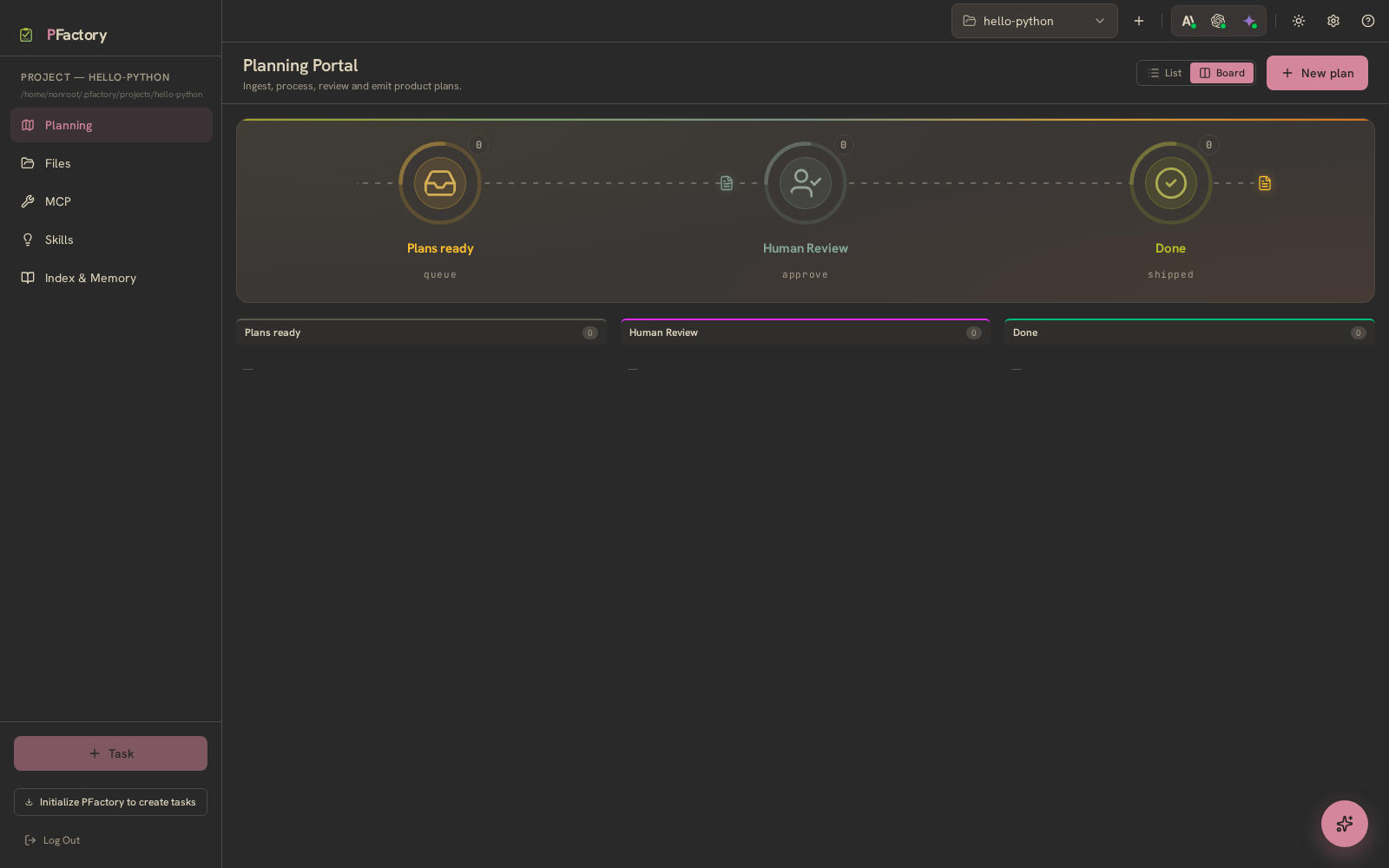
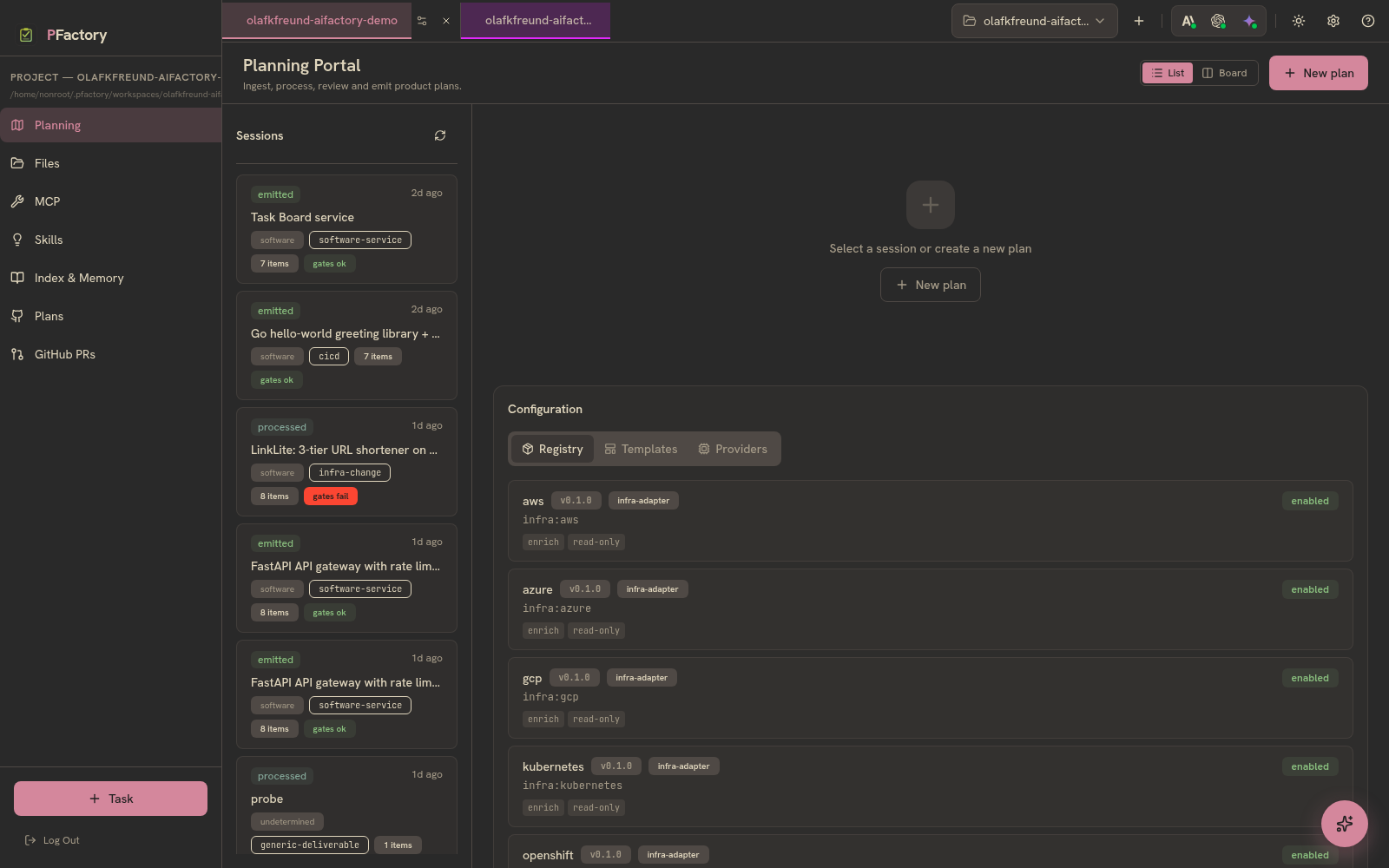
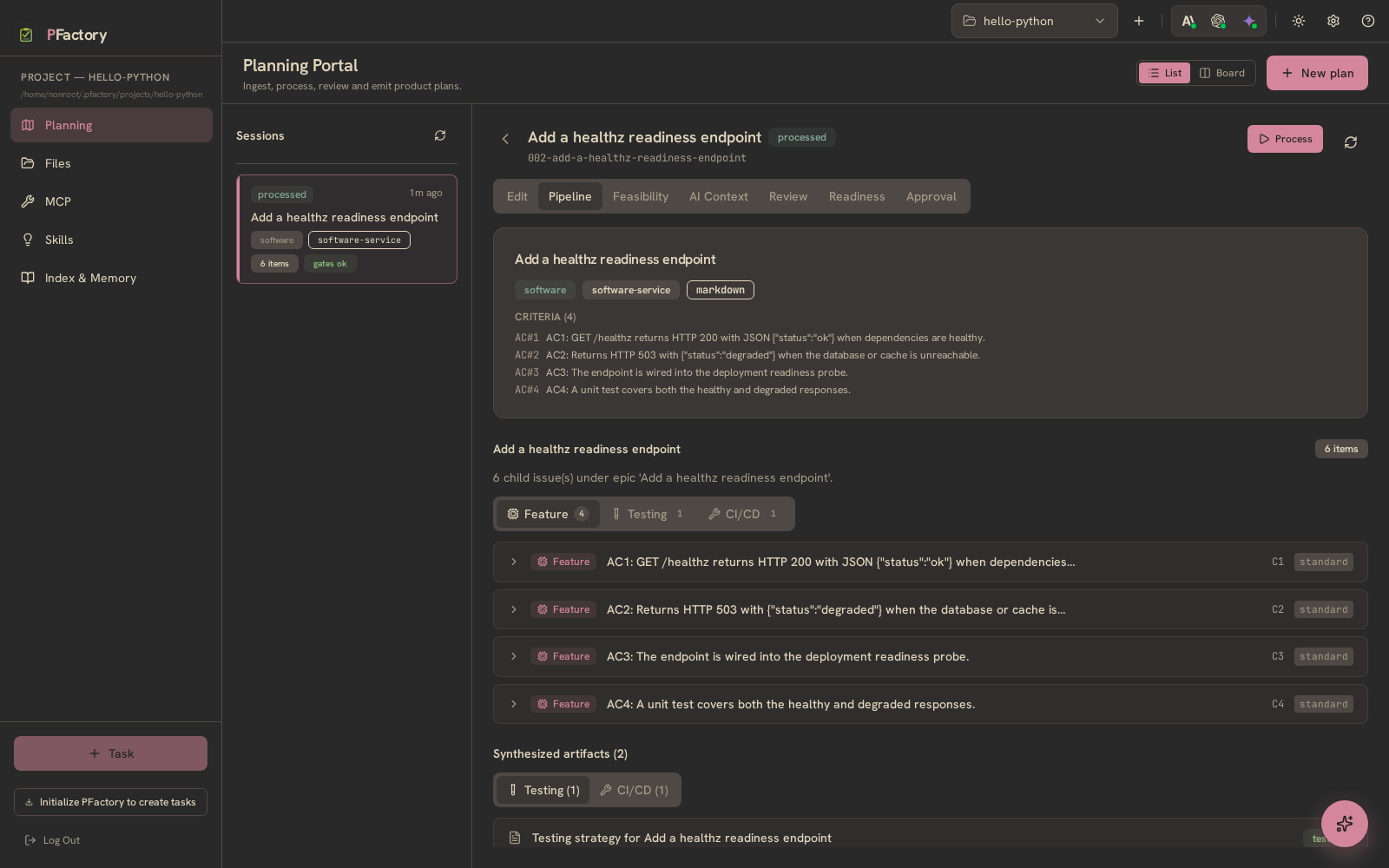
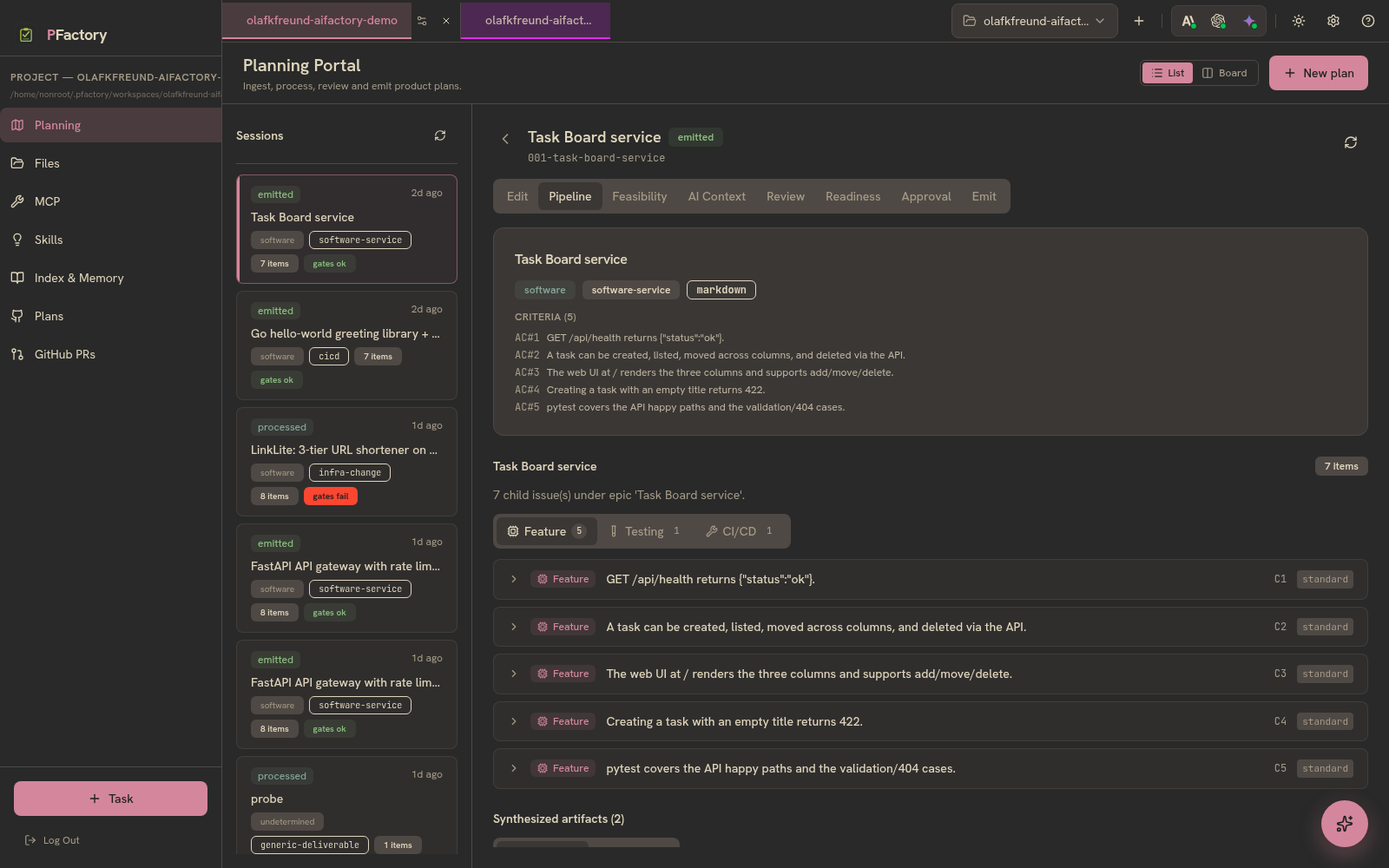
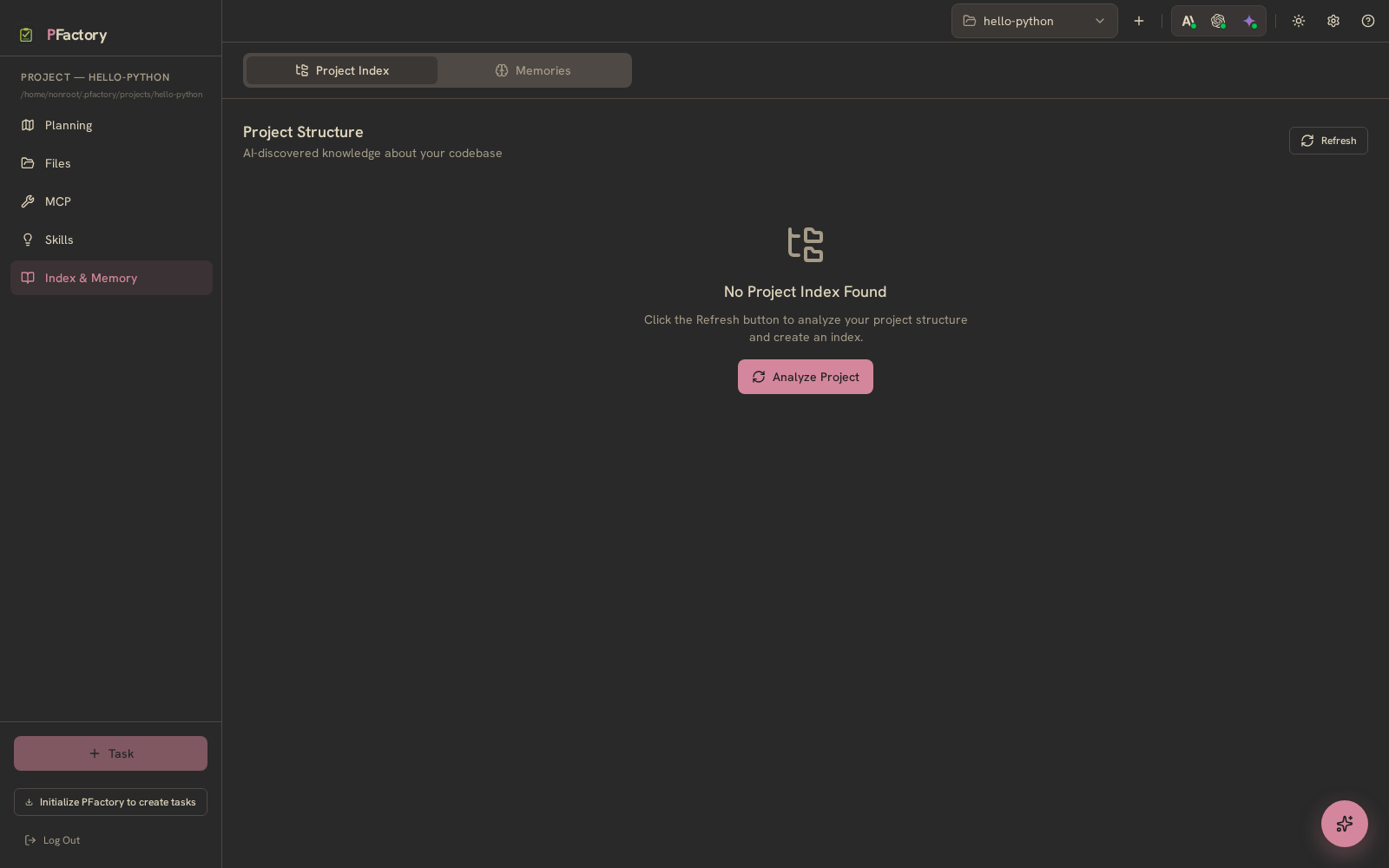
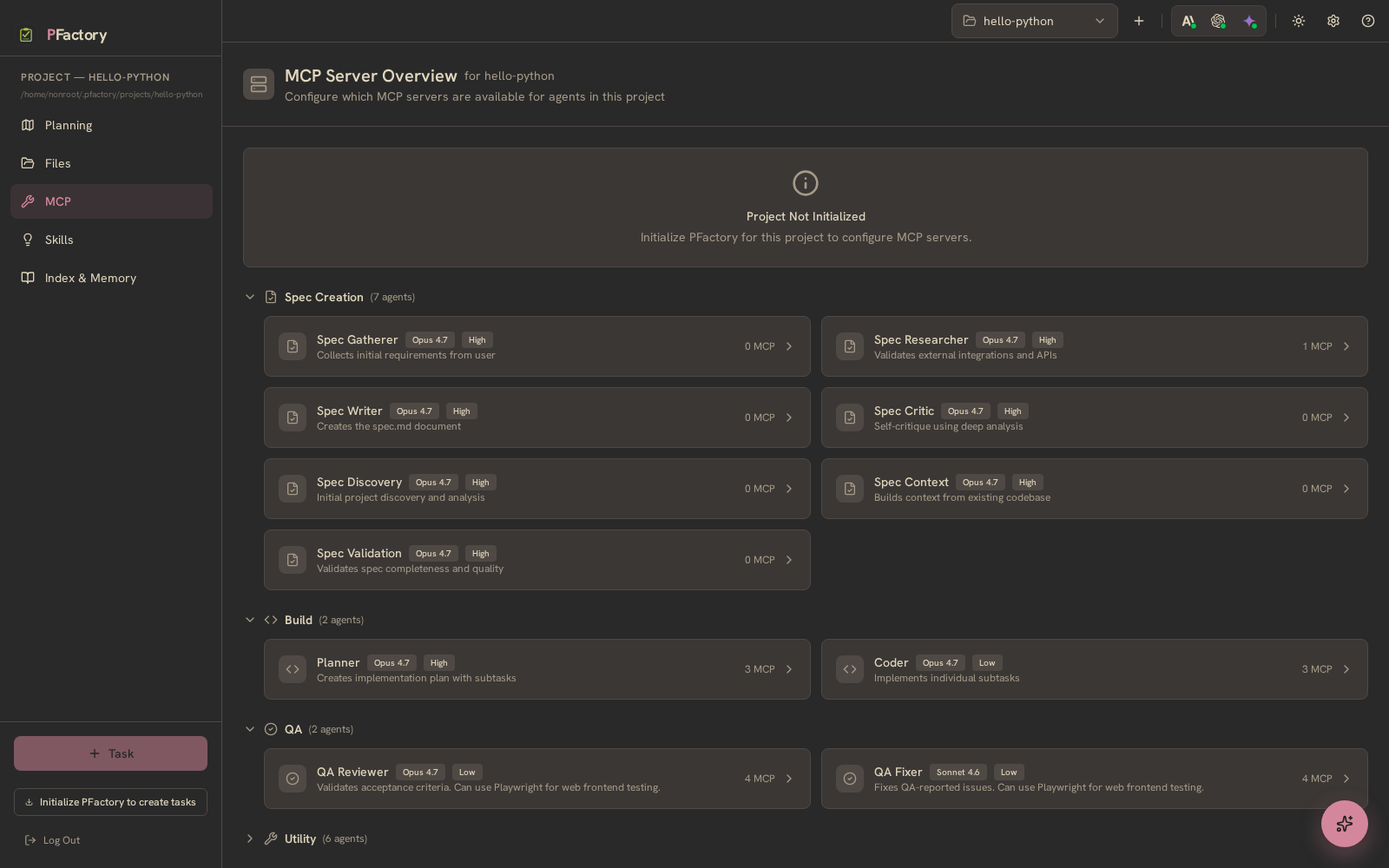
Ingest a plan → process → review across architecture · security · compliance · best-practice · feasibility · completeness lenses → red-team / adversarial pass → board → approve → emit tagged GitHub epics + issues. Captured from the live portal.

Why a planning factory
The 2026 coding agents — Devin, Factory’s droids, the Copilot coding agent — collapsed planning into execution: hand them a vague ask and they plan and build in one loop. That optimizes generation speed. But the real constraint is the opposite: the gap between what agents generate and what teams can confidently approve. PFactory makes the plan the reviewed, auditable artifact — so you get AI velocity with human-grade governance, grounded in your real infrastructure.
What PFactory does
-
Ingest any plan
Upload docx / pdf / markdown, or drive it from the MCP control plane, the CLI, or a GitHub issue / discussion. Software plans get the deep path; any deliverable is welcome.
-
Read the code first
Read-only reconnaissance of the target repo (static, blobless, never executes repo code) maps acceptance criteria to real files and takes the plan's language from the repo — no wrong-language traps. Then enrich with Backstage, wikis, and live Kubernetes · OpenShift · Azure · AWS · GCP · Terraform.
-
Decompose & define
Break the work into an epic + child issues with dependencies. For software, add a generated Testing Strategy and a CI/CD pipeline definition.
-
Govern, then hand off
Mandatory architecture / security / compliance / best-practice / feasibility / completeness lenses, a hard readiness gate (hash-bound waivers) honouring your SpecKit constitution, and one human approval — then emit a signed Task Contract + governed issues for AIFactory.
Plug in anything
PFactory is extensible by design. A declarative registry lets you add MCP
servers, skills, agents, and templates without forking. Cloud and IaC
best-practice MCP servers (AWS · Azure · GCP · Terraform) drive automatic
review. Templates are Backstage Software Template-compatible and carry their
own embedded policy rules — a gcp-project template scaffolds the project
and enforces its org policies, regions, and IAM baselines. As the clouds and
best practices change, PFactory watches them and proposes template updates via
pull request — never silent edits.
It also speaks GitHub’s native agentic surface: free
GitHub Models
inference (github-models/openai/gpt-4.1), copilot:delegate to hand a draft to
the Copilot cloud agent, and an HTTP MCP server (POST /mcp) that serves
the epic, requirements, decomposition, signed Task Contract v2, and review
status to whatever agent builds from the plan. All opt-in, all additive.
How it fits
PFactory is the third factory in the suite — plan → build → test, governed end to end:
One task, three factories
plan → build → testPFactory
Plans & governs
planAIFactory
Builds the code
codeTFactory
Verifies with tests
test| Factory | Role |
|---|---|
| PFactory | Plans & governs — ingest, enrich, decompose, review, emit issues |
| AIFactory | Executes — spec → plan → code → QA on the emitted issues |
| TFactory | Tests — generates & runs tests on the built code |
Documentation
-
Architecture
The eight-stage planning pipeline and how it transforms inputs into governed issues.
-
Roadmap
Phases P0–P8, the epic, and the 26 child issues that build PFactory.
-
Positioning
Where PFactory sits in the 2026 autonomous-engineering market, and the wedge.
-
Blog
Notes on AI planning, governance gates, and live-infrastructure grounding.
Tracking
- Epic + sub-issues → github.com/olafkfreund/PFactory/issues
- Source → github.com/olafkfreund/PFactory
- Executes the plans → github.com/olafkfreund/AIFactory
- License → MIT OR GPL-3.0